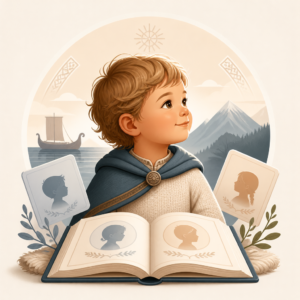
Norse names can offer a connection to Scandinavian language, medieval history and memorable mythology without all sounding alike. This guide brings together Old Norse names recorded in historical use, later Scandinavian forms and modern choices inspired by Viking stories. You will find Norse name meanings, pronunciation notes and helpful context for choosing a name for a baby, character or project. Some names are strongly associated with the Viking Age, while others became popular in Norway, Denmark, Sweden or Iceland much later. That distinction matters, so each entry identifies the most useful origin or usage note rather than treating every Scandinavian name as an identical “Viking” name.
Quick Picks: Popular-Style Norse Names and Meanings
| Name | Gender | Meaning | Origin or Usage |
|---|---|---|---|
| Astrid | Girl | Divinely beautiful | Scandinavian form of Old Norse Ástríðr |
| Bjorn | Boy | Bear | Old Norse bjǫrn; modern Scandinavian form Björn |
| Freya | Girl | Lady | Modern form of Old Norse Freyja |
| Gunnar | Boy | Battle warrior | Scandinavian form of Old Norse Gunnarr |
| Ingrid | Girl | Ing is beautiful | Old Norse and Scandinavian usage |
| Leif | Boy | Heir or descendant | Scandinavian form of Old Norse Leifr |
| Liv | Girl | Life | Scandinavian name; also linked to Old Norse Líf |
| Ragnar | Boy | Counsel or army | Old Norse Ragnarr |
| Sigrid | Girl | Victory and beauty | Scandinavian form of Sigríðr |
| Skadi | Girl | Mythological name | Modern form of Old Norse Skaði |
| Thor | Boy | Thunder | Modern form of Old Norse Þórr |
| Ulf | Boy | Wolf | Scandinavian form of Old Norse Úlfr |
| Vidar | Boy | Mythological name | Modern form of Old Norse Víðarr |
| Ylva | Girl | She-wolf | Modern Scandinavian name related to ulfr |
Old Norse Names for Girls
Many feminine Norse names combine elements associated with beauty, protection, victory, divine beings or family heritage. Spellings vary because Old Norse was written differently from modern Norwegian, Danish, Swedish and Icelandic.
Astrid
Astrid comes from Old Norse Ástríðr, generally understood through elements meaning “god” or “divine” and “beautiful.” The modern spelling is familiar across Scandinavia, while the historical form contains the accent.
Freya
Freya is the modern English and Scandinavian form of Old Norse Freyja, a name meaning “lady.” It is one of the best-known Norse mythology names and is often pronounced FRAY-uh in English.
Freydis
Freydis comes from Freydís, combining the name Freyja with dís, a word associated with a female spirit or goddess. The name is historically found in medieval Scandinavian naming.
Gudrun
Gudrun is the modern form of Old Norse Guðrún. Its elements are commonly interpreted as “god” and “secret lore” or “rune.” It appears in heroic and legendary Scandinavian tradition.
Helga
Helga comes from Old Norse heilagr, meaning “holy” or “blessed.” The masculine form is Helgi. Helga became established in several Scandinavian languages and is not limited to mythology.
Ingrid
Ingrid is related to Old Norse Ingríðr, traditionally interpreted as “Ing is beautiful.” Ing was an old Germanic deity or ancestral figure, making this a historical name with a graceful modern sound.
Ragnhild
Ragnhild comes from Old Norse Ragnhildr, combining elements associated with counsel or divine power and battle. The spelling Ragnhild remains especially recognizable in Norwegian usage.
Sigrid
Sigrid is the modern Scandinavian form of Sigríðr, usually explained as “victory” plus “beautiful.” It is an attested traditional name rather than a recent invention based only on Viking imagery.
Solveig
Solveig is a Scandinavian name with Old Norse roots, although its exact original interpretation is debated. It is often connected with ideas such as “sun” and “strength” or “way,” so careful sources may phrase the meaning differently.
Svanhild
Svanhild comes from Old Norse Svanhildr, generally understood as “swan” and “battle.” Its combination of a gentle animal image and a strong warrior element is typical of older Germanic naming.
Thyra
Thyra is a Danish and Scandinavian royal name with the Old Norse form Þýri or a related spelling. Its early etymology is uncertain, so it is better presented as a historically used name than given a forced translation.
Eir
Eir is a short Old Norse name associated in mythology with healing and mercy. The name is also used in modern Scandinavian naming, though its mythological associations should not be confused with a single universally agreed etymology.
Skadi
Skadi is the modern spelling of Old Norse Skaði, the name of a giantess and mountain-associated figure in Norse mythology. Its precise etymology is uncertain, but its cultural reference is clear.
Ylva
Ylva is a modern Scandinavian feminine name connected with ulv or Old Norse úlfr, “wolf.” It is best described as a later Scandinavian name inspired by an old word, rather than as a simple Viking Age feminine form.
Liv
Liv means “life” in modern Scandinavian usage and is also associated with Old Norse Líf, a survivor figure in the mythology of the world’s renewal. Its short spelling makes it easy to use internationally.
Viking Names and Old Norse Names for Boys
These masculine names include historically attested Scandinavian forms, names found in medieval literature and modern forms inspired by Norse gods or heroic tradition. “Viking name” is a broad modern label; not every name below belonged exclusively to raiders or warriors.
Bjorn
Bjorn is the Anglicized spelling of Scandinavian Björn, from Old Norse bjǫrn, meaning “bear.” The pronunciation is commonly BYORN or BYURN, depending on language and family preference.
Erik
Erik comes from Old Norse Eiríkr, usually interpreted through elements meaning “ever” or “always” and “ruler.” Erik is a long-established Scandinavian form; Eric is the common English variant.
Gunnar
Gunnar is the Scandinavian form of Old Norse Gunnarr, combining words associated with war and warrior. It is also prominent in Germanic heroic tradition, where spellings and stories vary.
Hakon
Hakon represents Norwegian Håkon, from Old Norse Hákon. It is commonly interpreted as “high son” or “noble son,” although translations of the first element can vary by source.
Harald
Harald comes from Old Norse Haraldr, built from elements meaning “army” and “ruler.” It is a historic Scandinavian royal name and has related forms such as Harold in English.
Ivar
Ivar is a modern Scandinavian form of Old Norse Ívarr. Its elements are usually connected with the yew tree and a warrior or bow-warrior idea, though detailed interpretations differ across etymological references.
Knut
Knut is the Scandinavian form of Old Norse Knútr, traditionally associated with “knot.” The English form Canute is familiar from medieval history, while Knut remains natural in Nordic languages.
Leif
Leif comes from Old Norse Leifr, meaning “heir,” “descendant” or “beloved possession” in different explanatory traditions. It is commonly pronounced LAYF in English and closer to LIFE in some Scandinavian settings.
Olaf
Olaf is the English form of Scandinavian Olav and Old Norse Óláfr, traditionally interpreted as “ancestor’s descendant.” It is an established historical name, not only a reference to Viking stories.
Ragnar
Ragnar comes from Old Norse Ragnarr, whose elements are generally linked with counsel, judgment or divine power and an army. It became especially familiar through legendary and later historical storytelling.
Rolf
Rolf is a Scandinavian form related to Old Norse Hrólfr, combining “fame” and “wolf.” Rudolf and the English Ralph belong to related Germanic naming families, although their modern forms differ.
Sigurd
Sigurd is the Scandinavian form of Old Norse Sigurðr, usually interpreted as “victory guardian.” It is strongly connected with the legendary dragon-slayer tradition, also known by the German form Siegfried.
Sven
Sven comes from Old Norse sveinn, meaning “boy,” “young man” or “young warrior.” It is a traditional Scandinavian name, with Sweyn and Svein as related historical spellings.
Thor
Thor is the modern form of Old Norse Þórr, whose name means “thunder.” It is one of the most recognizable mythology-inspired names, although its modern use extends well beyond historical Scandinavia.
Ulf
Ulf is the Scandinavian form of Old Norse Úlfr, meaning “wolf.” It was used as a personal name and also appears as an element in longer names such as Rolf.
Vidar
Vidar is the modern Scandinavian form of Old Norse Víðarr, the name of a son of Odin in Norse mythology. Its exact etymology is uncertain, so “mythological name” is more reliable than a fixed translation.
Freyr
Freyr means “lord” and is the name of a major Norse deity associated with prosperity, peace and fertility in surviving mythological sources. The name is usually pronounced FRAYR in English.
Balder
Balder is a modern form related to Old Norse Baldr, a beloved god in Norse mythology. The name’s exact meaning is uncertain, despite some popular explanations connecting it with brightness or courage.
Loki
Loki is a mythological name from Old Norse tradition. Its etymology is debated, so it should not be assigned a confident literal meaning; its strongest association is with the complex trickster figure in the myths.
Frode
Frode comes from Old Norse Fróði, commonly associated with wisdom, learning or being wise. It is a traditional Scandinavian name and is distinct from the modern English word “fro,” despite the similar spelling.
Asger
Asger is a Danish form related to Old Norse Ásgeirr, combining “god” or “deity” with “spear.” The related Norwegian form is often written Åsgeir.
Halfdan
Halfdan comes from Old Norse Hálfdan, literally “half-Dane” or “half Danish.” It was a genuine historical name, but its original social meaning should not be assumed for modern families.
Gender-Neutral and Mythology-Inspired Norse Names
Gender categories can change across countries and time. The following choices are best treated as flexible modern options, word names or mythological references rather than claims that every one was historically unisex.
Ari
Ari is a short name found in Icelandic and other Nordic usage. In Old Norse, ari can be associated with “eagle,” while related forms and meanings vary across languages, so context matters.
Dag
Dag comes from the Old Norse word for “day.” It is a concise Scandinavian personal name and can suggest brightness or a new beginning without requiring a direct mythological connection.
Rune
Rune is a modern Scandinavian given name connected with Old Norse rún, meaning “secret,” “mystery” or “rune.” It can also be understood as a reference to the old writing system and its inscriptions.
Storm
Storm is a Scandinavian nature name using the ordinary word for a storm. It is more accurately described as a modern Nordic-style name than as a clearly documented Viking Age personal name.
Orm
Orm means “serpent” or “dragon” in Old Norse and appears in historical Scandinavian naming. The name is short, bold and more unusual today than many familiar Norse choices.
Arne
Arne is a Scandinavian name related to Old Norse Arni and the word for “eagle.” It has long usage in Nordic countries and may be used independently or as a short form.
Sol
Sol is related to Old Norse Sól, the personified sun in Norse mythology. In modern naming it may be used as a compact nature name, though spelling and gender associations differ by country.
Bryn
Bryn is used in Scandinavian naming and can be associated with “armor” through a Norse name element. It also has Welsh usage with a different history, so families should check which tradition they intend.
Understanding Norse Name Meanings and Usage
“Norse,” “Old Norse,” “Scandinavian” and “Viking” are related but not interchangeable labels. Old Norse was the language used across parts of medieval Scandinavia, while Viking generally describes a period of travel, trade, raiding and settlement rather than a nationality. A name may have Old Norse etymology, be recorded in Icelandic sagas, become traditional in Norway or Denmark, and still have a different modern spelling in English.
Historical names were often built from meaningful elements such as gunn (“battle”), sig (“victory”), bjǫrn (“bear”) or rún (“secret” or “rune”). However, some mythological names have uncertain etymologies. For those names, it is more honest to identify the cultural association than to present a doubtful translation as fact. If you enjoy names from neighboring European traditions, compare them with these guides to German names and their meanings or Greek names with historical origins.
Pronunciation and Spelling Notes
- The Old Norse letter þ, called thorn, represents a “th” sound. Thus Þórr becomes Thor in modern spelling.
- The letter ð also represents a dental sound and is commonly simplified to d in forms such as Sigurd.
- Modern Scandinavian spellings may use letters such as å, ä, ö or ø. Björn, Bjørn and Bjorn are related forms, but local pronunciation differs.
- English pronunciation is not always the same as Scandinavian pronunciation. If a name will be used internationally, decide whether you prefer historical accuracy, local usage or easy English pronunciation.
How to Choose a Norse Name
Start by deciding what kind of connection you want. A historically attested name such as Leif, Astrid or Gunnar gives a stronger link to Scandinavian naming tradition. A mythology-inspired choice such as Freya, Thor or Skadi creates a more recognizable story association. A nature-based name such as Ulf, Orm or Sol may feel distinctive without requiring a child to explain a complex legend.
Next, say the full name aloud with the family surname. Check whether accents and special letters are practical where you live, and look up the pronunciation used by your family’s preferred Nordic language. Finally, consider whether the meaning is genuinely documented or simply repeated in popular baby-name lists. For more international comparison, our Russian names guide and collection of Korean names and usage notes show why language and cultural context matter when researching name meanings.
Frequently Asked Questions
What is the difference between Norse names and Viking names?
Norse names come from the language and naming traditions of medieval Scandinavia. “Viking names” is a broader modern phrase that may include historical Scandinavian names, saga names and names inspired by Norse mythology.
What are some popular-style Norse names for girls?
Astrid, Freya, Ingrid, Sigrid, Liv, Gudrun and Solveig are strong choices. Some are historical Scandinavian names, while Freya and Skadi also have well-known mythology connections.
What are some Old Norse names for boys?
Bjorn, Leif, Gunnar, Erik, Ragnar, Sigurd, Ivar, Ulf and Thor are widely recognized options. Their spellings and pronunciations can change between Old Norse, modern Scandinavian languages and English.
Are all Norse names connected to warriors?
No. Norse naming includes meanings connected with family, beauty, life, animals, nature, wisdom, religion and mythology as well as battle and protection.
How should I verify a Norse name meaning?
Check the name’s Old Norse form, word elements, historical usage and modern language form separately. If an etymology is disputed, treat the meaning as uncertain rather than relying on a simplified popular translation.

1 thought on “Norse Names: 120 Old Norse & Viking Names With Meanings”