
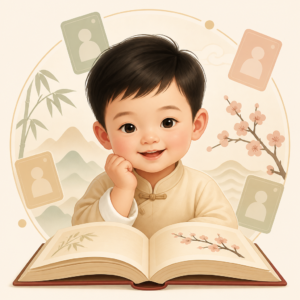
Chinese names can be elegant, concise and deeply meaningful, but their meanings depend on the Chinese characters chosen rather than on romanized spelling alone. This guide to Chinese names includes beautiful ideas for girls, boys and gender-neutral use, with pinyin pronunciation, character meanings and notes about modern naming customs. You will find familiar choices such as Mei and Ming alongside less expected ideas such as Rui, Ning and Tian. Because the same sound may be written with several different characters, treat each meaning below as a character-based interpretation and confirm the exact written form before making a final choice.
Quick Picks: Beautiful Chinese Names
| Name | Gender | Meaning | Origin/Usage |
|---|---|---|---|
| Mei (美) | Girl | Beauty | Mandarin Chinese |
| Lan (兰) | Girl | Orchid | Mandarin Chinese |
| Ning (宁) | Any | Peace, calm | Modern Chinese usage |
| Jing (静) | Girl | Quiet, tranquil | Mandarin Chinese |
| Yue (月) | Any | Moon | Poetic Chinese usage |
| Hao (浩) | Boy | Vast, expansive | Mandarin Chinese |
| Ming (明) | Boy | Bright, clear | Mandarin Chinese |
| Wei (伟) | Boy | Great, grand | Mandarin Chinese |
| Jun (俊) | Boy | Talented, handsome | Mandarin Chinese |
| Jia (嘉) | Any | Good, admirable | Modern Chinese usage |
| Rui (瑞) | Any | Auspicious | Mandarin Chinese |
| Chen (晨) | Any | Morning, dawn | Modern Chinese usage |
| Lin (琳) | Girl | Beautiful jade | Mandarin Chinese |
| Bo (博) | Boy | Broad learning | Mandarin Chinese |
Chinese Girl Names
Many Chinese baby names for girls draw on beauty, nature, virtue and precious materials. The choices below are character-based examples. Some may be used alone as given names, while others can form part of a two-character name chosen by a family.
Mei (美)
Mei means “beauty” or “beautiful” when written with 美. It is short, familiar internationally and easy to pronounce, although Mei can represent other characters and meanings in different names.
Hua (花)
Hua means “flower” with 花, giving this name a bright and natural image. The sound may also be written with 华, meaning splendid or flourishing, so the selected character matters.
Lan (兰)
Lan means “orchid” with 兰, a graceful floral choice in Chinese naming. It is pronounced approximately lah n, with a rising Mandarin tone.
Jing (静)
Jing means “quiet,” “still” or “tranquil” with 静. It has a calm, refined feeling and may be combined with another character to create a fuller two-syllable given name.
Ying (莹)
Ying can mean “lustrous” or “clear as jade” with 莹. This gives the name a polished, precious quality, though other characters pronounced Ying have unrelated meanings.
Yue (月)
Yue means “moon” with 月 and has a poetic, nature-inspired quality. Its pronunciation is close to yweh in Mandarin, rather than the English word “you.”
Xin (欣)
Xin means “joy” or “happiness” with 欣. It is a warm choice for parents who want a name associated with delight and optimism.
Ning (宁)
Ning means “peaceful” or “calm” with 宁. It can be feminine, masculine or gender-neutral depending on the complete name and family preference.
Fang (芳)
Fang means “fragrant” or “aromatic” with 芳 and is often associated with flowers and graceful character. The same pinyin can be written with several different characters.
Yan (燕)
Yan means “swallow,” referring to the bird, with 燕. It is a traditional nature name and can also appear in names using other Yan characters.
Qing (清)
Qing means “clear,” “pure” or “clean” with 清. It offers a simple, serene image, though Qing is also used with characters carrying different meanings.
Lin (琳)
Lin means “beautiful jade” with 琳. It is an attractive choice for a girl’s name because jade imagery suggests beauty and value without requiring a literal translation.
Wen (文)
Wen means “culture,” “writing” or “refinement” with 文. It can be used for any gender, and its scholarly association makes it especially appealing in a thoughtful, literary name.
Rong (蓉)
Rong can refer to the hibiscus flower with 蓉. It has a soft botanical feeling and is often considered feminine in contemporary use.
Jiao (娇)
Jiao means “delicate,” “lovely” or “charming” with 娇. Because character associations can shift by context, families may pair it with another character to create a more specific meaning.
Hui (慧)
Hui means “wisdom” or “intelligence” with 慧. It is a strong virtue-based option for parents who want the name to express thoughtfulness and insight.
Chinese Boy Names
Popular Chinese names for boys often express strength, learning, brightness, ambition or good character. These meanings are not fixed personality predictions; they are wishes and associations attached to the chosen characters.
Wei (伟)
Wei means “great,” “mighty” or “grand” with 伟. It is a familiar masculine given-name character, while other Wei characters can produce entirely different meanings.
Ming (明)
Ming means “bright,” “clear” or “understanding” with 明. It is one of the most accessible Chinese name ideas for English speakers and has a positive intellectual association.
Hao (浩)
Hao means “vast” or “boundless” with 浩. The character is often connected with the broadness of water or the sky, creating an expansive and energetic impression.
Jun (俊)
Jun means “handsome,” “talented” or “outstanding” with 俊. It is commonly used in masculine names, although gender associations may vary across families and regions.
Chen (辰)
Chen means “morning” or can refer to a traditional time or celestial association with 辰. It is also a common surname, so the full name should be checked for sound and flow.
Yang (阳)
Yang means “sun,” “sunlight” or the active, bright principle of yin-yang thought with 阳. In a personal name, it usually conveys warmth and vitality rather than a single literal translation.
Lei (雷)
Lei means “thunder” with 雷. It is a bold nature choice with a strong sound, suitable for parents seeking a name with energy and presence.
Tao (涛)
Tao means “great waves” or “surging water” with 涛. The character gives the name a powerful natural image and is distinct from Tao as a broader philosophical term.
Bo (博)
Bo means “broad,” “extensive” or “learned” with 博. It is a concise name associated with knowledge, curiosity and a wide outlook.
Jie (杰)
Jie means “outstanding” or “heroic” with 杰. It is a confident virtue-style name and can be used in a longer given name with another character.
Long (龙)
Long means “dragon” with 龙. Dragons have an important place in Chinese culture, but the name should be understood through its cultural symbolism rather than treated as a generic fantasy label.
Feng (峰)
Feng means “mountain peak” with 峰. It suggests height, steadiness and achievement, while Feng written as 风 means “wind,” showing why the character must be confirmed.
Qiang (强)
Qiang means “strong” or “powerful” with 强. This direct character meaning makes it a clear choice for parents looking for a name expressing resilience.
Yi (毅)
Yi means “firm,” “resolute” or “persevering” with 毅. It is a virtue-based masculine choice that focuses on determination rather than physical strength.
Zhi (志)
Zhi means “will,” “ambition” or “aspiration” with 志. It can suggest purposeful character and is often suitable for a name built around hopes for the future.
Kun (坤)
Kun refers to earth or the receptive principle in classical Chinese thought with 坤. It has a traditional, philosophical quality and may be especially appealing in a formal or heritage-focused name.
Gender-Neutral Chinese Names
Chinese given names do not always fit neatly into Western gender categories. A character may feel more feminine or masculine in one generation, region or family, while a complete two-character name can change the impression. These are flexible options, not universal gender labels.
An (安)
An means “peace,” “safety” or “calm” with 安. It is one of the simplest gender-neutral Chinese names and works well as either a short given name or part of a longer name.
Jia (嘉)
Jia means “good,” “excellent” or “admirable” with 嘉. It has a positive, polished sound and is widely adaptable in modern given names.
Rui (瑞)
Rui means “auspicious” or “fortunate” with 瑞. It is a hopeful choice for any gender and has a pleasant, compact pronunciation.
Chen (晨)
Chen means “morning” or “dawn” with 晨. This character is distinct from 辰, even though both are commonly romanized as Chen.
Tian (天)
Tian means “sky” or “heaven” with 天. It creates an open, elevated image and can be used in modern names for any gender.
Lin (林)
Lin means “forest” with 林. It is a nature-based option that differs from 琳, the character meaning beautiful jade, despite identical pinyin.
Qing (青)
Qing can refer to blue-green or youthful freshness with 青. It has a literary and natural feeling, although its exact translation depends on context.
Yuan (元)
Yuan can mean “origin,” “first” or “beginning” with 元. It is a meaningful choice for families drawn to ideas of beginnings and possibility.
Xin (心)
Xin means “heart” or “mind” with 心. It is less conventional as a standalone given name in some settings, but it can inspire a distinctive character-based choice.
Yu (宇)
Yu means “universe,” “roof” or “spacious” with 宇. The same spelling may represent 雨, meaning “rain,” so the written character should always be specified.
Jing (景)
Jing can mean “scenery,” “view” or “bright” with 景. It is a versatile, image-rich character that may suit a complete name for any gender.
Hui (辉)
Hui means “radiance” or “splendor” with 辉. It conveys light and achievement, while 慧, another Hui, means wisdom.
Kai (凯)
Kai means “triumphant” or “victorious” with 凯. It is often perceived as masculine in modern use, but naming conventions are not identical in every Chinese-speaking community.
Yun (云)
Yun means “cloud” with 云. It is a gentle nature image and may be used in poetic or contemporary names for different genders.
Cheng (成)
Cheng means “to accomplish,” “become” or “succeed” with 成. It expresses progress and completion, making it a practical virtue-inspired choice.
How Chinese Names Work: Characters, Order and Pronunciation
Chinese is a language family with several varieties, and Mandarin is only one commonly used variety. A name’s pronunciation may change in Cantonese, Hokkien, Shanghainese or another language, while the written characters may remain recognizable. Nationality, language, family background and place of residence should not be treated as interchangeable.
In the standard modern Chinese name order, the family name usually comes first and the given name follows. Given names are often one or two characters, but romanization can hide important differences. For example, Ming, Mei, Yu and Chen each correspond to multiple characters and therefore do not have one universal meaning. Ask which characters the family intends to use, and check the tones if accurate Mandarin pronunciation matters.
Some names in this guide are single-character given names; others can be combined with a second character. A combination should be reviewed as a whole for sound, tone, regional usage and the meaning of the family surname. Avoid translating every character too literally: a name may express an elegant image or a hoped-for virtue rather than a complete sentence.
How to Choose Chinese Baby Names
- Start with the characters. Choose the intended written form before settling on an English spelling or pronunciation.
- Say the full name aloud. Check the tones in Mandarin and consider how the surname and given name sound together.
- Consider cultural connection. A name is most respectful when it reflects genuine family, linguistic or cultural ties rather than a decorative stereotype.
- Check regional forms. A name that sounds natural in Mandarin may be pronounced differently in another Chinese language.
- Think about everyday use. Decide whether the child will use pinyin, another romanization system, an English name or the Chinese name in different settings.
If you are comparing naming traditions, our guides to Japanese names and their meanings and Japanese boy names offer a useful reminder that characters, pronunciation and cultural context all matter. For fictional naming, you can also browse these random name ideas for broader inspiration, then verify any Chinese-language choice with a fluent speaker.
Final Thoughts on Chinese Names
The best Chinese name is not simply the one with the most attractive English translation. It should work in its intended language, use characters whose meaning the family understands and sound natural with the surname. Whether you prefer a peaceful name such as An, a nature choice such as Yue or a virtue name such as Yi, confirm the characters and pronunciation before deciding. That small step turns a beautiful idea into a name with clear, respectful meaning.
Frequently Asked Questions
Do Chinese names have one fixed meaning?
No. Meaning depends on the Chinese characters used. The same romanized spelling can represent several different characters, pronunciations or meanings.
Does the family name come first in Chinese names?
Usually, the family name comes first and the given name follows in standard Chinese name order. Usage can vary in international settings, so check the family’s preferred format.
Are Chinese names gender-specific?
Some names are more commonly associated with girls or boys, but many characters and complete given names can be used flexibly. Associations may vary by region, generation and family.
How should Chinese names be pronounced?
Pronunciation depends on the language or variety being used, such as Mandarin or Cantonese. For Mandarin, check the pinyin spelling and tone rather than relying only on an English approximation.
Can I choose a Chinese name without knowing the characters?
It is better to choose the characters first or consult a fluent speaker. A romanized name alone may have several possible meanings and may not sound natural in the intended language.

3 thoughts on “Chinese Names: 150 Beautiful Names With Meaning of Origins”